

Eggs Can Be Made Safer For Raw Recipes, But Only If You Get This Exactly Right
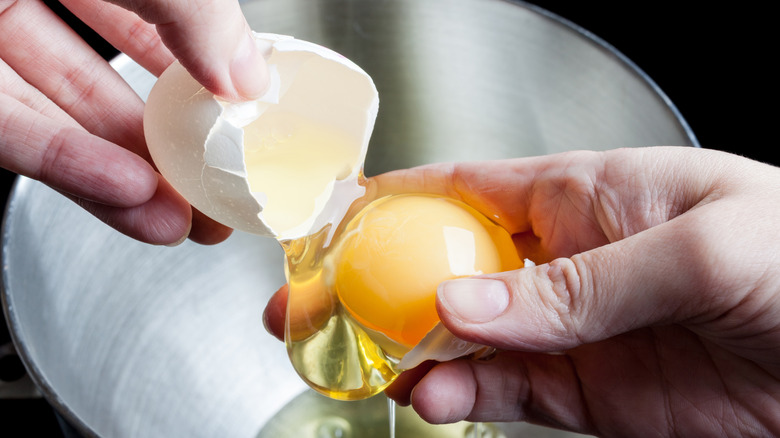
From scratch-made mayo to tiramisu, there are more than a few recipes that call for raw eggs. They're even a crucial component of certain drinks, whether you're whipping up a batch of eggnog or shaking up a frothy egg-white sour cocktail. Some folks may be put off by the idea of consuming uncooked eggs, and that's understandable. It's a well-known food safety fact among home cooks that raw eggs may carry Salmonella, a bacteria that can cause all sorts of unpleasant gastrointestinal issues and has the potential to be life-threatening in severe cases. So, how do we get away with using raw eggs safely without getting sick?
In the 19th century, French scientist Louis Pasteur discovered that heating food or drinks to a specific temperature for a set amount of time could kill harmful bacteria without fully cooking the item in question. The process — now known as pasteurization — completely revolutionized food safety and is still one of the most effective ways to reduce the risk of foodborne illness in products like milk, juice, and eggs. If you plan on making something that calls for raw eggs, you should buy them pasteurized. But if that's not possible, you can always try doing it yourself.
According to The American Egg Board, the easiest and safest way to pasteurize eggs at home is to stir your desired number of eggs together with water, sugar, or the liquid components of the recipe you're making. For this method to work, you'll need to use at least ¼ cup of liquid per egg. Add the mixture to a heavy saucepan and cook it at a low heat, stirring the whole time. Once the egg solution creates a film over a metal spoon, check the temperature to ensure that it is 160 degrees Fahrenheit or above. Then, move the saucepan into an ice water bath and stir the egg solution as it cools. Your still-liquid eggs are now pasteurized and ready for use. If this all sounds too complicated and time consuming or you're worried about getting it just right, buying commercially pasteurized eggs is always a reliable option.
Why pasteurizing whole eggs in a hot water bath is not recommended
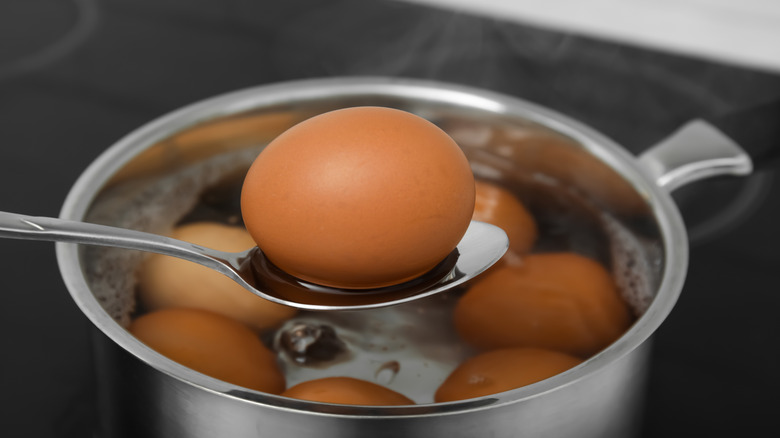
If you overheat your eggs in the water bath — or heat them for too long — they'll partially cook. While the bacteria might be dead, your raw eggs are no longer raw, making them unsuitable for your recipe. Luckily, we can check whether a whole egg has been accidentally cooked instead of pasteurized by cracking it open. A pasteurized egg shouldn't look much different from a regular raw egg. The yolk should be glossy and runny, and if it appears jammy or firm, it likely got too hot. Meanwhile, the white should be loose and translucent — a little cloudiness is fine, but if it's milky or opaque, it means it started to cook.
However, if the egg looks raw and we want to know whether it's been successfully pasteurized, we run into an issue. Unfortunately, there's no way to tell if a whole egg is properly pasteurized without being able to test the internal temperature, and there isn't a kitchen tool for this. You would need to somehow make sure the center of the yolk is reaching and consistently staying at the correct temperature of 140 degrees Fahrenheit or slightly above for at least three and a half minutes as it cooks. This is obviously not possible with a whole egg, and the issue is further compounded by the fact that water baths heat inconsistently, which could cause the egg's internal temperature to fluctuate.
The longer an egg stays below the ideal temperature, the greater the risk of contamination by Salmonella and other pathogens. On the other side of the coin, eggs held above this temperature for too long will partially cook and lose their desirable texture. Assuming you somehow pulled this off, you would also need to diligently inspect your eggs for cracks. Egg shells act as a natural barrier against contamination, and a break in this barrier makes it possible for bacteria to re-enter the egg, even after pasteurization. You'd then either need to finish cooking the egg, or throw it away. This difficulty and lack of certainty is why home pasteurization is riskier than buying commercially pasteurized products, and the FDA and USDA both recommend fully cooking eggs before eating them.